Bangkok
Thailand
Some cities are made to be visited; others, to be inhabited for a few days, slowly finding their way under your skin. Bangkok belongs to the latter: not a succession of places to tick off a list, but a full encounter with the senses, made of heat and overlapping scents, spiritual silences and street noise, hands passing you food even when you share no common language. Let yourself be permeated by the city, and somehow it may permeate you in return.
Bangkok is remarkably easy to move through. For all its scale, the city doesn't seem to create barriers: almost everything feels reachable by tuk-tuk or from the back of a motorbike, even when enormous buildings and shopping centres suddenly open up behind the street, containing entire worlds within them.
There is a kind of peaceful chaos to Bangkok. Movement is constant, but it doesn't overwhelm or collide with you; paradoxically, it seems to move around you. Even in the middle of traffic and noise, nothing feels particularly hurried.
Bangkok lends itself to travellers willing to be carried by it rather than simply tick off its sights: those curious about the body, food and the senses, prepared to move without a rigid agenda and to trust instinct and chance.
Curator & Photographer: Stefania Zanetti, Editor: Ottavia Mapelli
Capella Bangkok
Make Capella Bangkok, in the Sathon district, your base: a place to leave in the morning and return to at the end of each day - although it may make leaving surprisingly difficult.
Every room looks out over the river, and the comfort, however complete, never feels elitist. Thai hospitality remains strongly present even within the hotel, creating a sense of welcome that keeps you connected to the city outside.
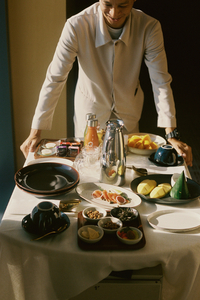
Food is part of the experience too. On the first floor, the cooking stays closer to Thai tradition; higher up, the approach becomes meticulous and Michelin-starred, with the light at sunset falling directly and delicately across the plates. The dishes are by Cola Greco and cooked by Chef Davide, with a largely Italian team that stimulates the palate without losing the distinctly Thai hospitality that can be felt throughout the hotel.
Bangkok through food
From restaurants redefining hospitality to street stalls appearing at unpredictable hours, food may easily become the thread running through your time in Bangkok, in all its forms.
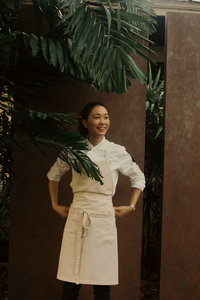
At Baan Tepa, in Bang Kapi, Chef Tam welcomes her guests with an openness that is not always a given from someone working in a kitchen at this level. Together with her sister, who manages communications, she brings a remarkably personal dimension to the experience.
Tam is gentle yet assured, smiling and creating a healthy, relaxed atmosphere around her. There is also something about the way femininity is expressed here that resists banal interpretations: mature, serious and entirely beside the point when considering the value of her work. To speak about her restaurant means leaving gender prejudice behind.
Before service begins, the team observes a minute of spiritual silence — a simple gesture that feels deeply respectful on a human level.
Street food & markets
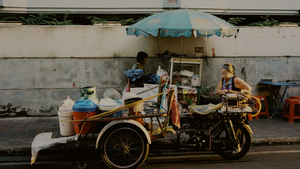
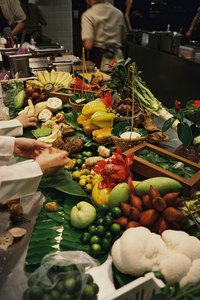
Outside, Bangkok's markets and street food can win you over with their disarming simplicity.
Even at the most local stalls, where language becomes an obstacle and the cultural distance can be felt, it remains possible to customise a dish. There is a flexibility to the way food is prepared that makes it surprisingly easy to adapt something to individual tastes and needs.
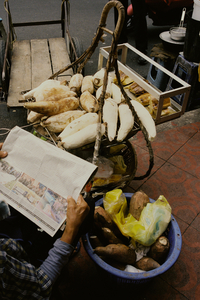
Street food here is mobile, created almost from nothing and handed over in small bags. You choose it not through excess, but instinct. Stalls appear at strategic moments throughout the day, and one of the pleasures of eating this way is precisely not having to organise everything in advance: trust chance and explore whatever happens to be there.
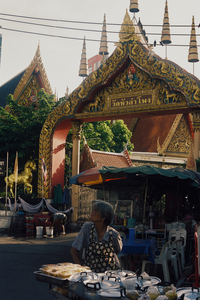
Around the city's residential areas, you may find a multitude of these stalls in complete contrast with the tall buildings rising above them, with their swimming pools and gyms - and, nestled among them, small temples.
Bangkok's sweet side
Bangkok's street desserts, particularly around Pathum Wan, play with textures and often come in a soup-like format - something that can overturn the very idea of dessert you are accustomed to.
Try the bua loy at Joe Wan, with jellies and endless possibilities of colourful toppings, ranging from juicy to dense and chewy. It is worth discovering if you're willing to question your familiar categories of taste.
Yowarat: where cultures meet
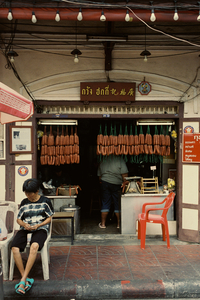
Chinatown, and Yaowarat in particular, tells a different story from the rest of Bangkok: one of two cultures that have met and lived alongside one another for so long that they have almost merged.
Red and gold signs mix with Thai Buddhist temples; the scents of Chinese spices intertwine with basil and lemongrass. As you walk, it becomes increasingly difficult to draw a clear boundary between the two identities.
It is a layering that never feels forced. Instead, it seems like a natural coexistence, grown over time until it has become a language of its own - one recognisable only in Bangkok
Yaowarat still preserves much of its Chinese tradition. The signs of shops, hotels, eateries and restaurants continue to be written in Chinese, while traditional medicine pharmacies punctuate the streets. Their windows are filled with roots, dried herbs and jars holding ancient knowledge: another expression of the way these two cultures meet and speak to one another.
Describing Yaowarat remains genuinely difficult. To understand it, you have to feel it and experience it, because so much of what defines the neighbourhood lies in its atmosphere.
The city through the body
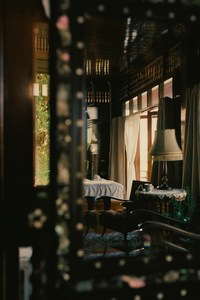
Bangkok may make you curious about the body, too.
With so many different forms of massage to experience, the interest goes beyond simply looking for a moment of relaxation. Instead, they offer a way to understand the lens through which the body is seen here: how it is approached, how it is perceived and how different Thai massage traditions relate to it.
Exploring these traditions can become part of experiencing Bangkok itself, rather than simply a way to relax between one part of the city and the next.
A slower Bangkok
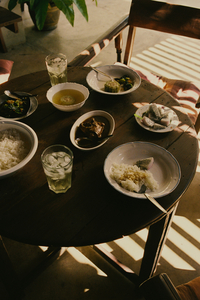
For a refuge from the city's chaos, Bangkok Noi, on the outskirts of Bangkok, offers a different, more worldly dimension and the chance to experience a slower rhythm.
A homestay here can reveal this side of the city from the very beginning of the day. Breakfast might mean rice, vegetables you've never seen before and spiced meat, with exotic animals in view around you.
That contrast is perhaps one of the things we loved most about Bangkok. The city can be immense and intimate, highly polished and improvised, intensely urban and unexpectedly slow, sometimes within the space of the same day.
And perhaps this is also why Bangkok stayed with us. Not because of one definitive sight or experience, but because it never really asked to be understood from a distance. It asked us to eat, touch, listen, move and pay attention - to loosen our grip on the itinerary and allow the city to reveal itself on its own terms.